 Click to enlarge
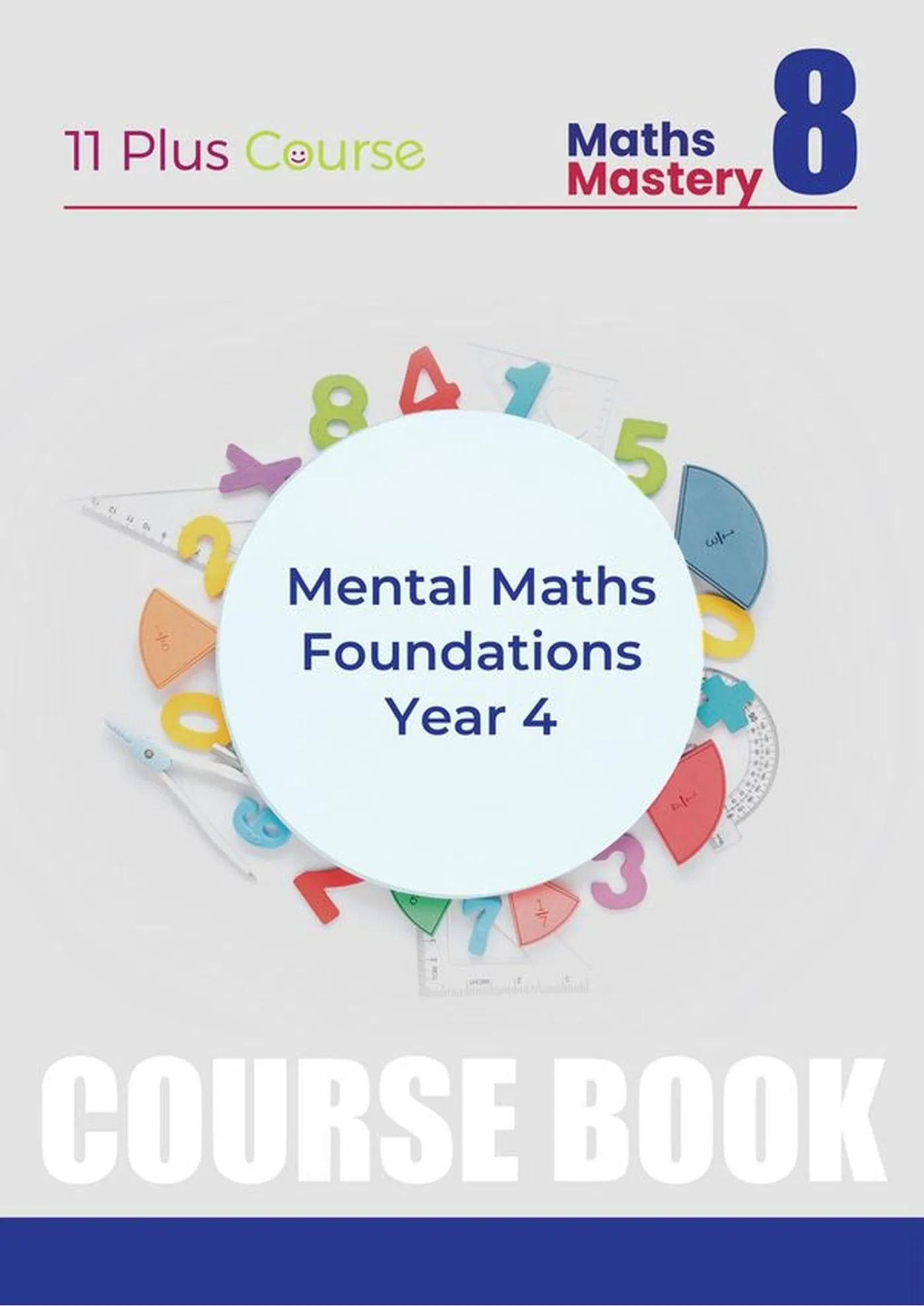
Mental Maths Foundations
The Year 4 mental maths book. Speed and accuracy without a pen.
- 29 tests in ten levels
- 30 questions per test, every strand of KS2 number
- A progress tracker: three attempts per test
- Every answer with its method fully worked
Want the whole series? The full Maths series is £247, under £21 a book.
How this book is used in our course
Three short tests a week, no pen for the working. Each test is attempted up to three times; a level is only finished when the child is accurate and quick, and then the next level begins.
Where it sits in the series
- Previous book in the series: Book 7, Maths Rules & Quick Tests
- Next book in the series: Book 9, Short Maths
What's inside Maths Mastery 8
Five real pages from the book, so you can see exactly what your child will work from. All 10 sample pages are in the viewer.
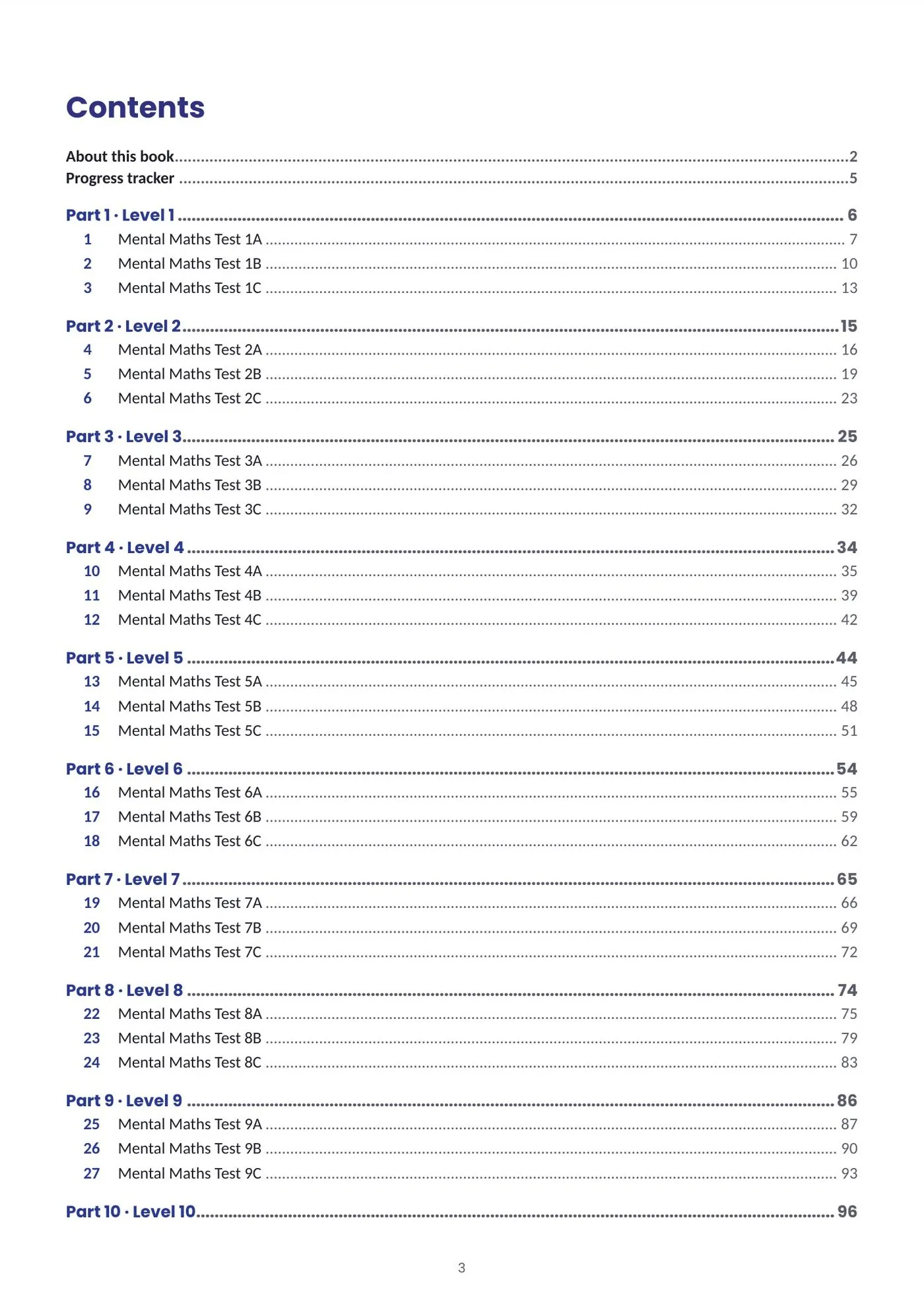
Ten levels of tests, from the first week of Year 4 to exam speed.
Twenty-nine mental maths tests of 30 questions, arranged in ten levels. Tests 1A, 1B and 1C are Level 1; the child moves up a level only when the level below is secure. Each test is 15 minutes, no calculator, working in the margin. The ladder is the point: a child who starts at Level 1 in September and reaches Level 10 is at the speed the 11+ demands.
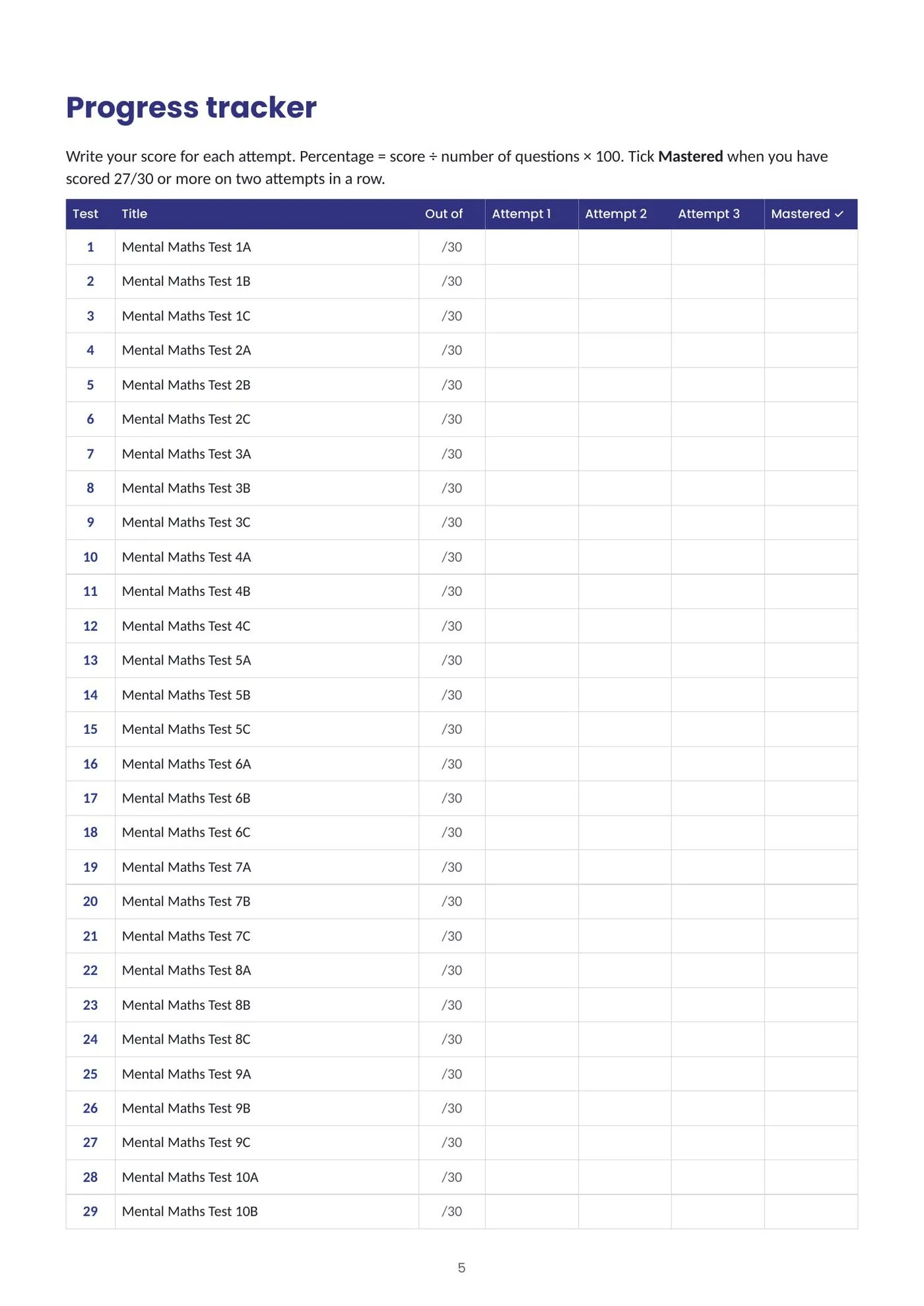
Three attempts per test, and a definition of mastered that a child cannot argue with.
Every test has a row: score out of 30 for attempt 1, 2 and 3, and a tick for Mastered. Mastered means 27 out of 30 or better on two attempts in a row, not once on a good day. A parent can see the whole year on one page: which levels are ticked, which test was attempted three times, and where the child is right now.
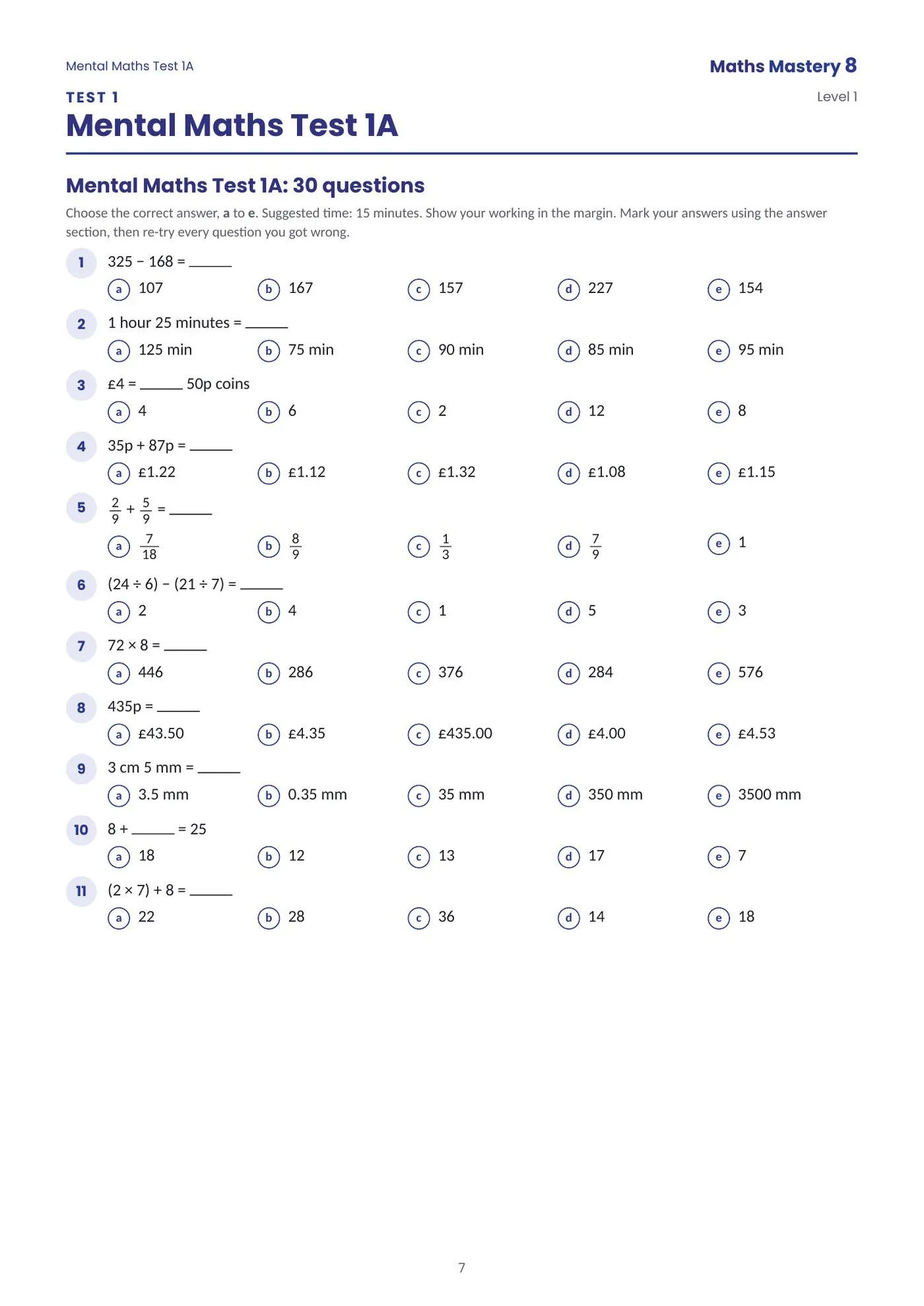
Level 1 is where the exam’s mental arithmetic begins: money, time, fractions, brackets.
Test 1A opens with 325 − 168, then 1 hour 25 minutes in minutes, 50p coins in £4, 35p + 87p, 2/9 + 5/9, and (24 ÷ 6) − (21 ÷ 7). Thirty questions in 15 minutes, five answer choices each, with the distractors chosen from the mistakes children actually make. These are the questions a Year 4 child should be able to do without a pen by Christmas.
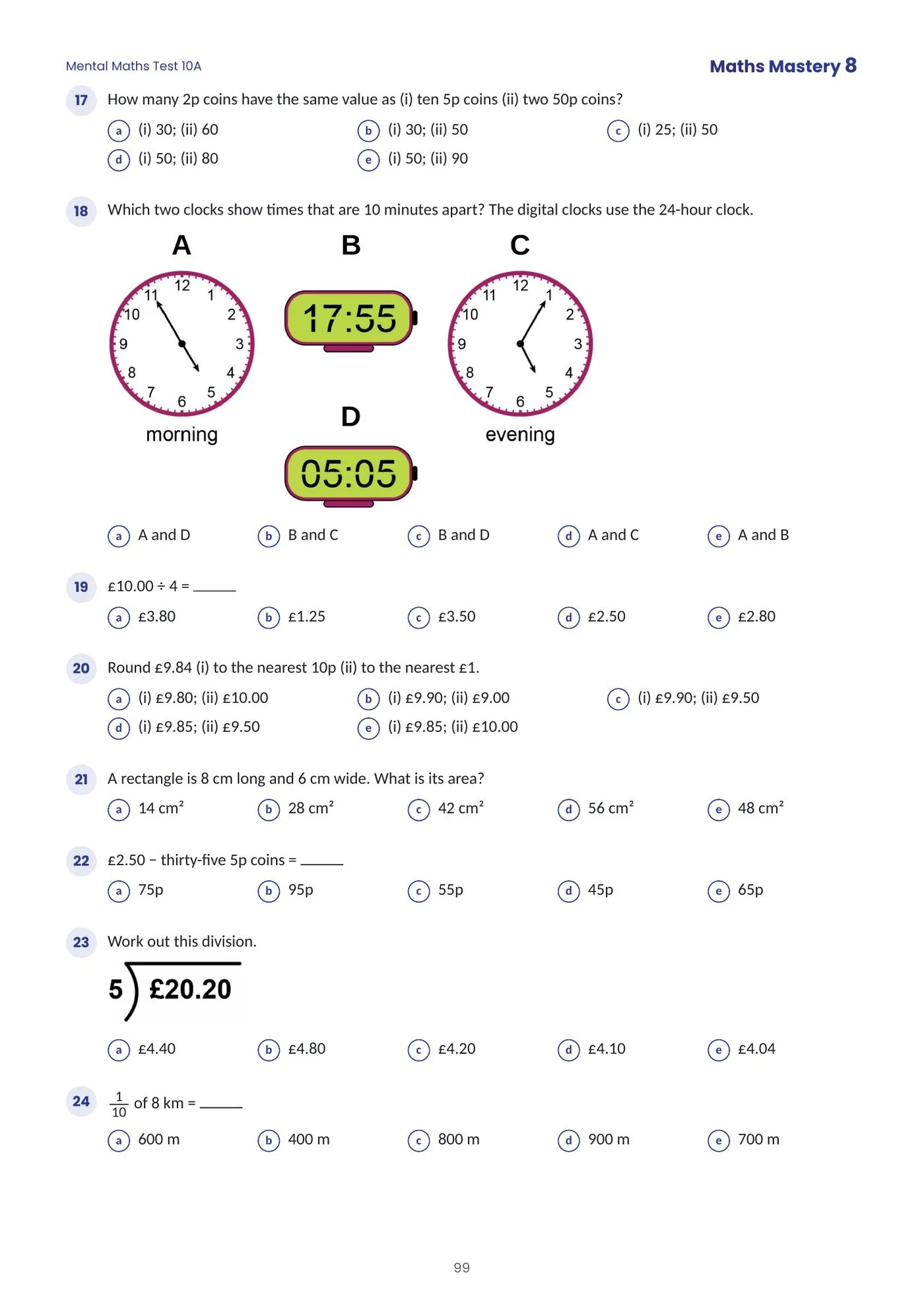
Level 10: the questions a child must answer in under 30 seconds on the day.
Which two clocks show times ten minutes apart, with two analogue and two 24-hour digital clocks. £2.50 minus thirty-five 5p coins. Round £9.84 to the nearest 10p and the nearest £1. £20.20 ÷ 5. A tenth of 8 km in metres. None of it is hard once the Level 1 to 9 work is done; all of it is lost if a child is still counting on fingers.
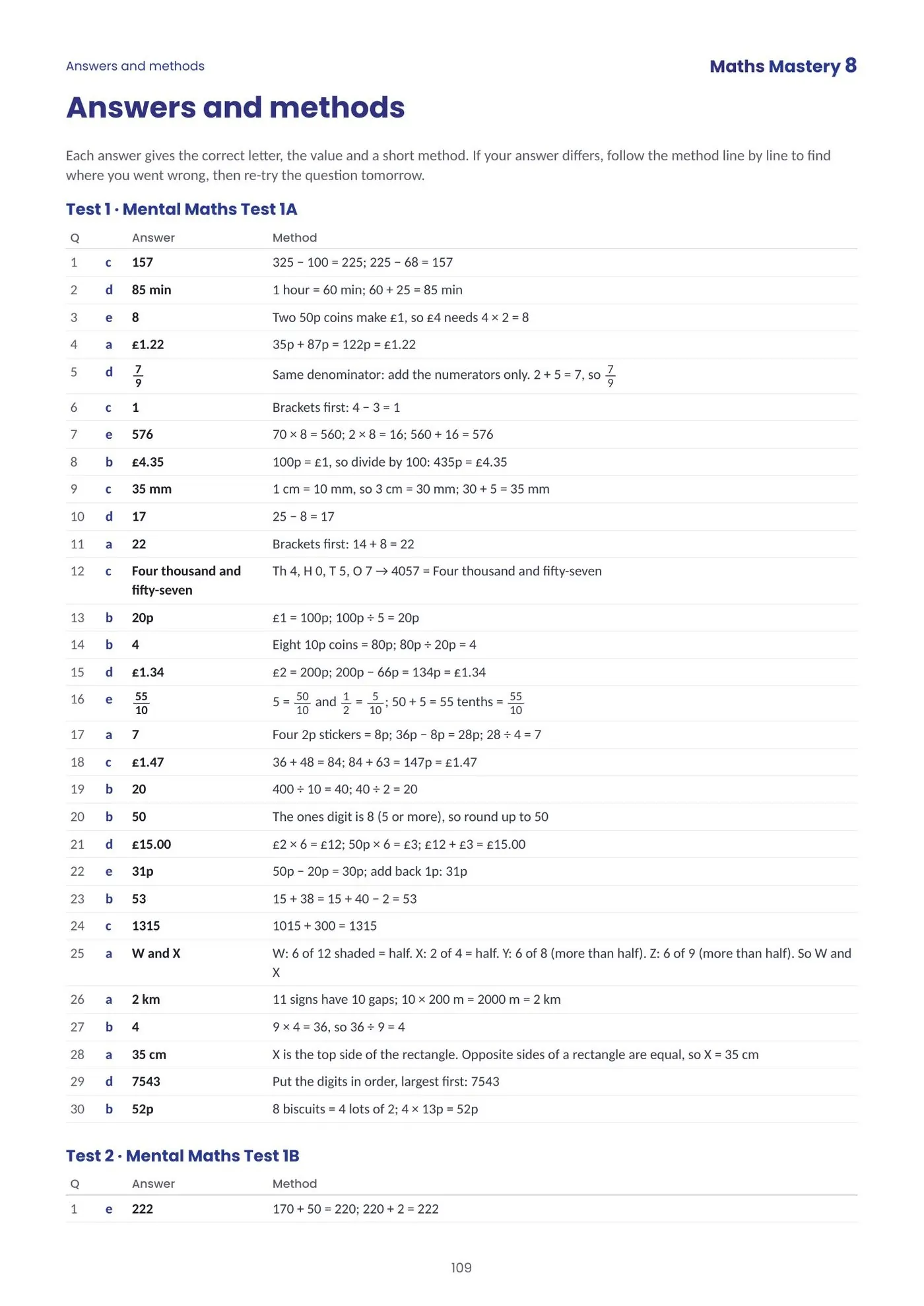
Every answer, every method, fully worked.
The method column is the mental strategy, not the written one: "325 − 100 = 225; 225 − 68 = 157", "15 + 38 = 15 + 40 − 2 = 53", "11 signs have 10 gaps". A child who got it wrong is shown how a fast child thinks about the same question, and that is what moves them up a level.
All 29 tests in the book follow the pattern shown here.
Other Year 4 books in Maths Mastery

Number Relationships & Decimals
Place value, number bonds, factors, multiples and decimals: the ground every later topic stands on.

Fractions, Measures, Money & Time
The four topics that account for most lost marks in Year 4 maths, taught as one connected system.

Percentages, Ratios, Proportions & Probability
Proportional reasoning, the single skill that separates top-set maths from the rest.

Geometry: Shape, Space & Angles
Perimeter, area, angles, coordinates and nets, with the diagrams children actually meet in the exam.