 Click to enlarge
Fractions, Measures, Money & Time
The four topics that account for most lost marks in Year 4 maths, taught as one connected system.
- A rules page before every topic, written so a parent can teach from it
- 25 multiple-choice questions per topic, graded from accessible to scholarship level
- Full answer key
- Covers the whole 11+ syllabus across Books 1–6, then applies it in Books 7–12
Want the whole series? The full Maths series is £247, under £21 a book.
How this book is used in our course
Each topic opens with a rules page. A parent reads it with the child, then the child attempts the 25 questions unaided. Mark them, log the score, and work through every wrong answer with the key. Anything under 90% is repeated after a fortnight. The topic is only finished when the cold repeat clears 90%.
Where it sits in the series
- Previous book in the series: Book 1, Number Relationships & Decimals
- Next book in the series: Book 3, Percentages, Ratios, Proportions & Probability
What's inside Maths Mastery 2
Five real pages from the book, so you can see exactly what your child will work from. All 9 sample pages are in the viewer.
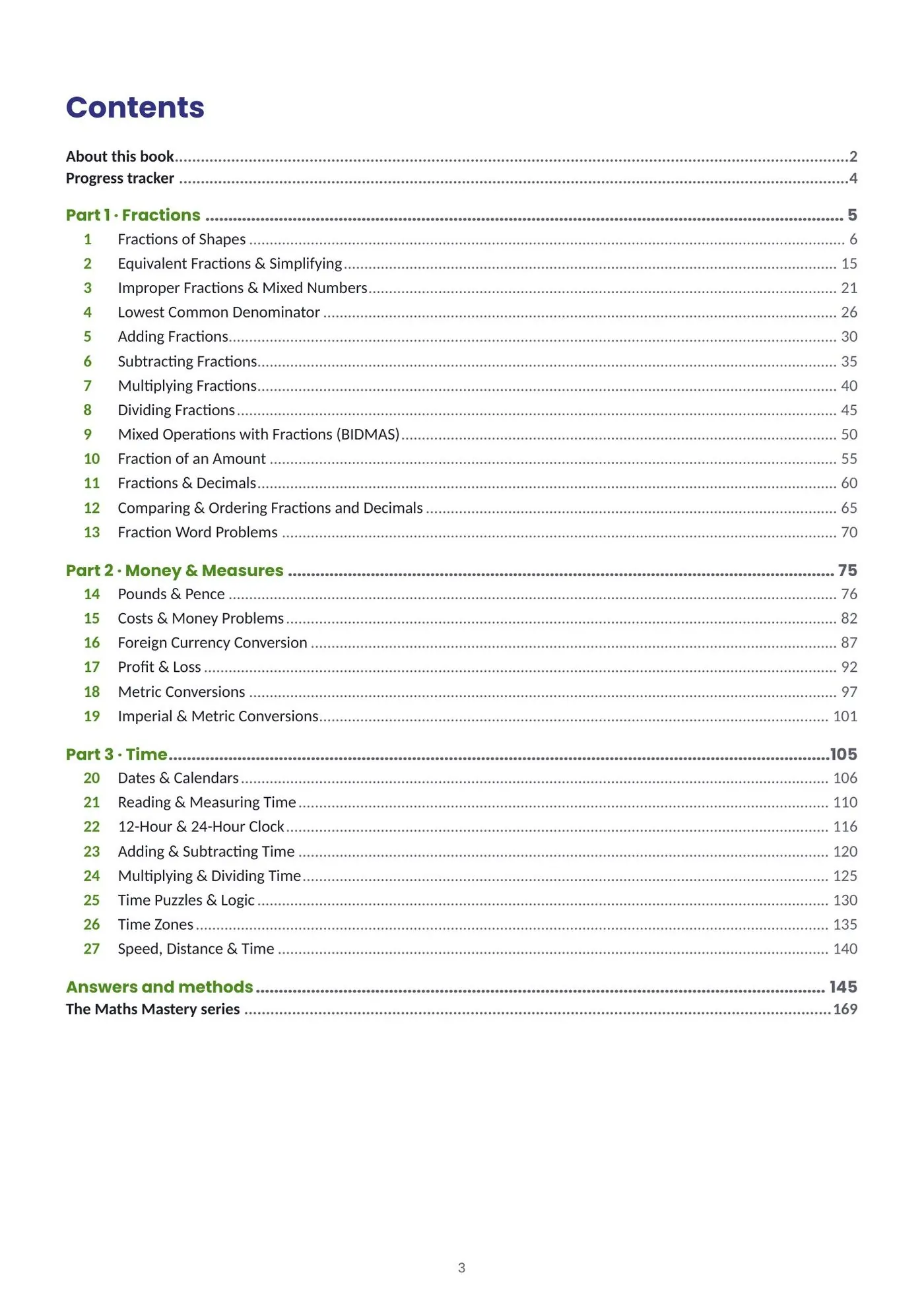
Twenty-seven topics in three parts: the ones that lose most marks in Year 4.
Part 1 takes fractions from shapes to word problems, through equivalence, mixed numbers, the four operations and fraction of an amount. Part 2 covers money and measures, including foreign currency, profit and loss and imperial conversions. Part 3 does time properly: calendars, clocks, 24-hour, time zones, and speed, distance and time.
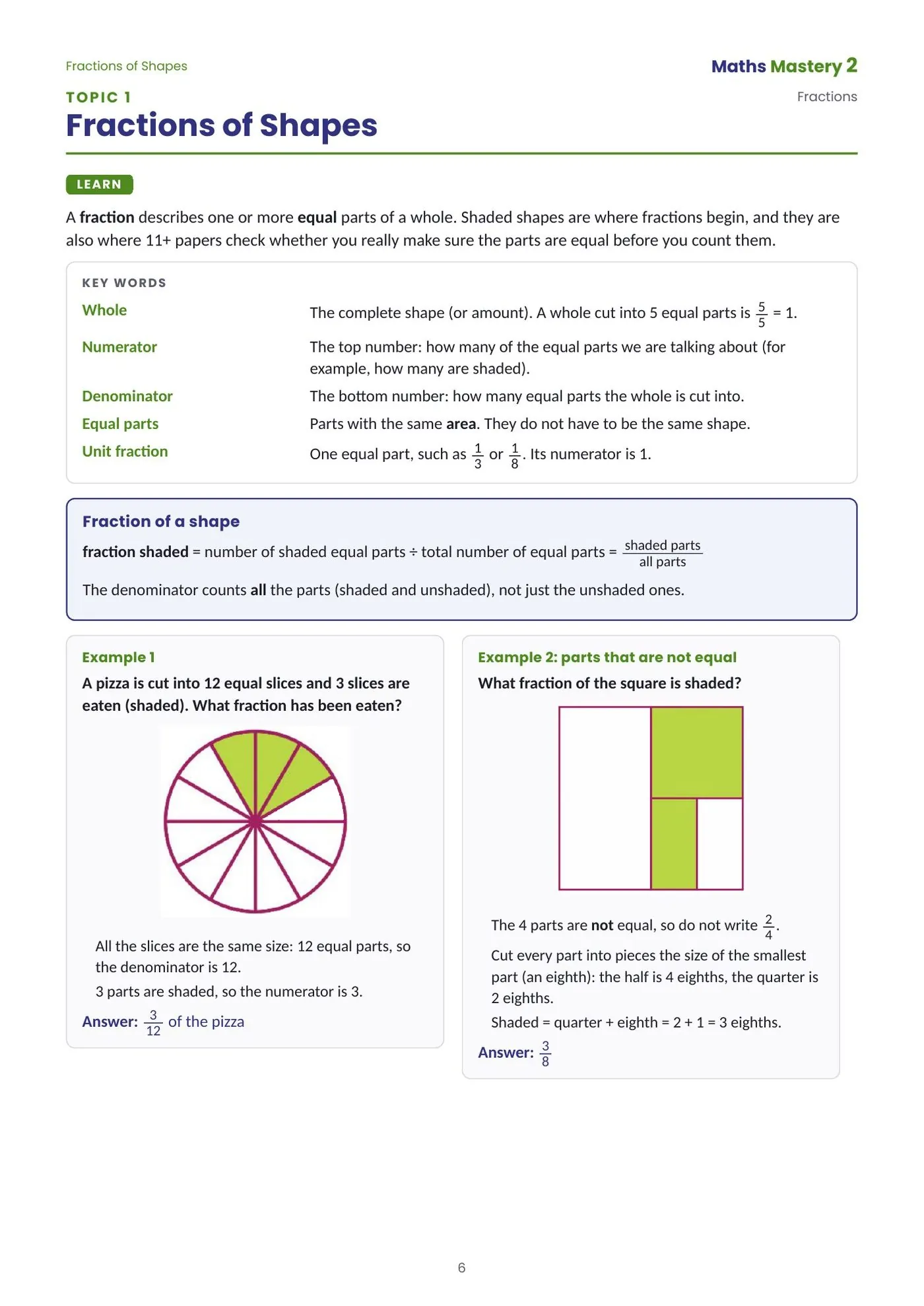
Fractions begin with shapes, and so do the exam’s traps.
The learn page says it plainly: 11+ papers check whether a child makes sure the parts are equal before counting them. Example 2 is a square cut into four unequal parts, where the wrong answer is 2/4 and the right one is 3/8. Key words first, rule in a box, then examples.
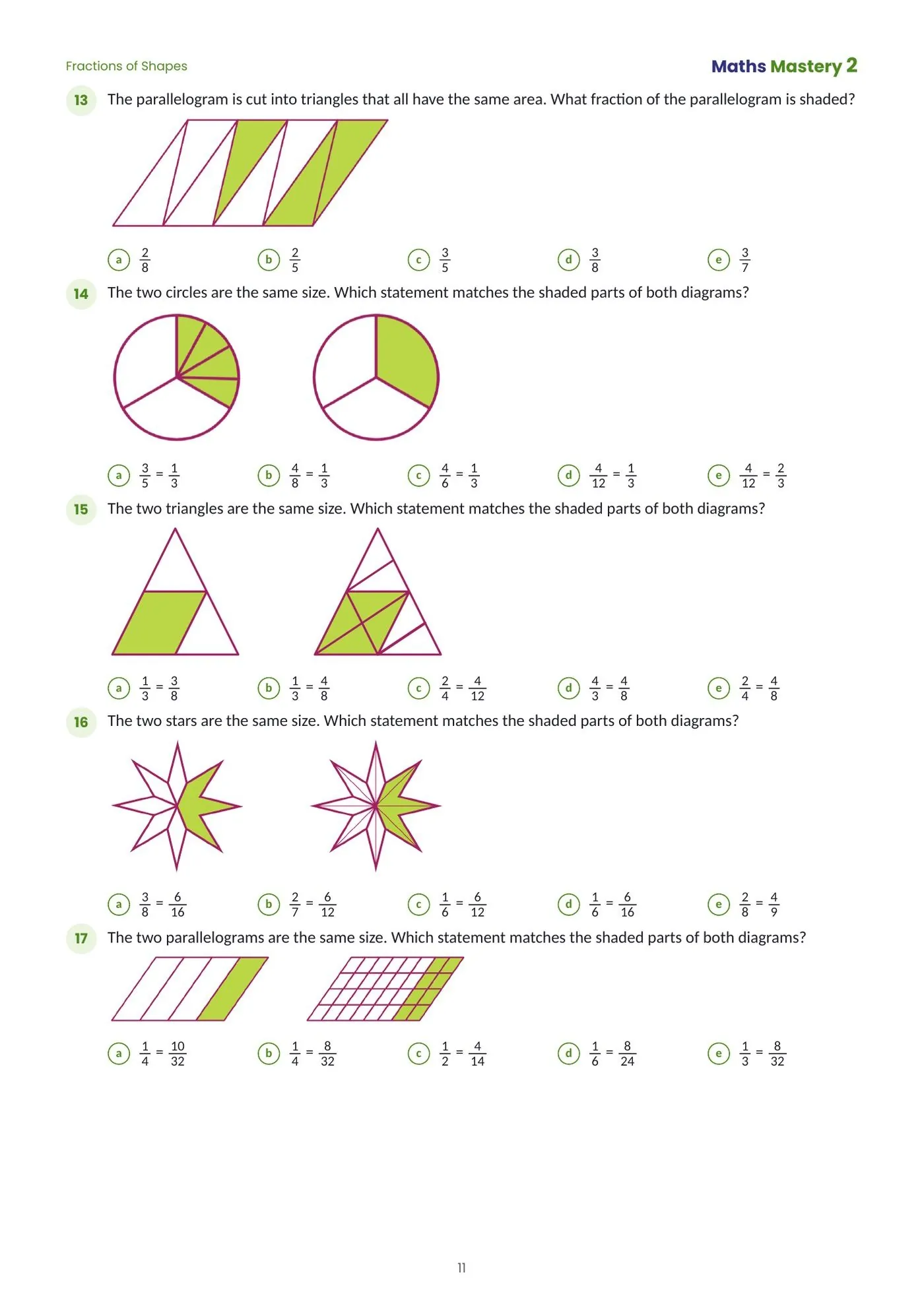
Then the questions that need the method, not a guess.
Parallelograms cut into triangles, two circles shaded differently, stars and triangles subdivided so that the child has to prove 1/3 = 4/12 rather than see it. These are the diagram questions grammar and independent schools set. A child who has only coloured in pizzas cannot do them.
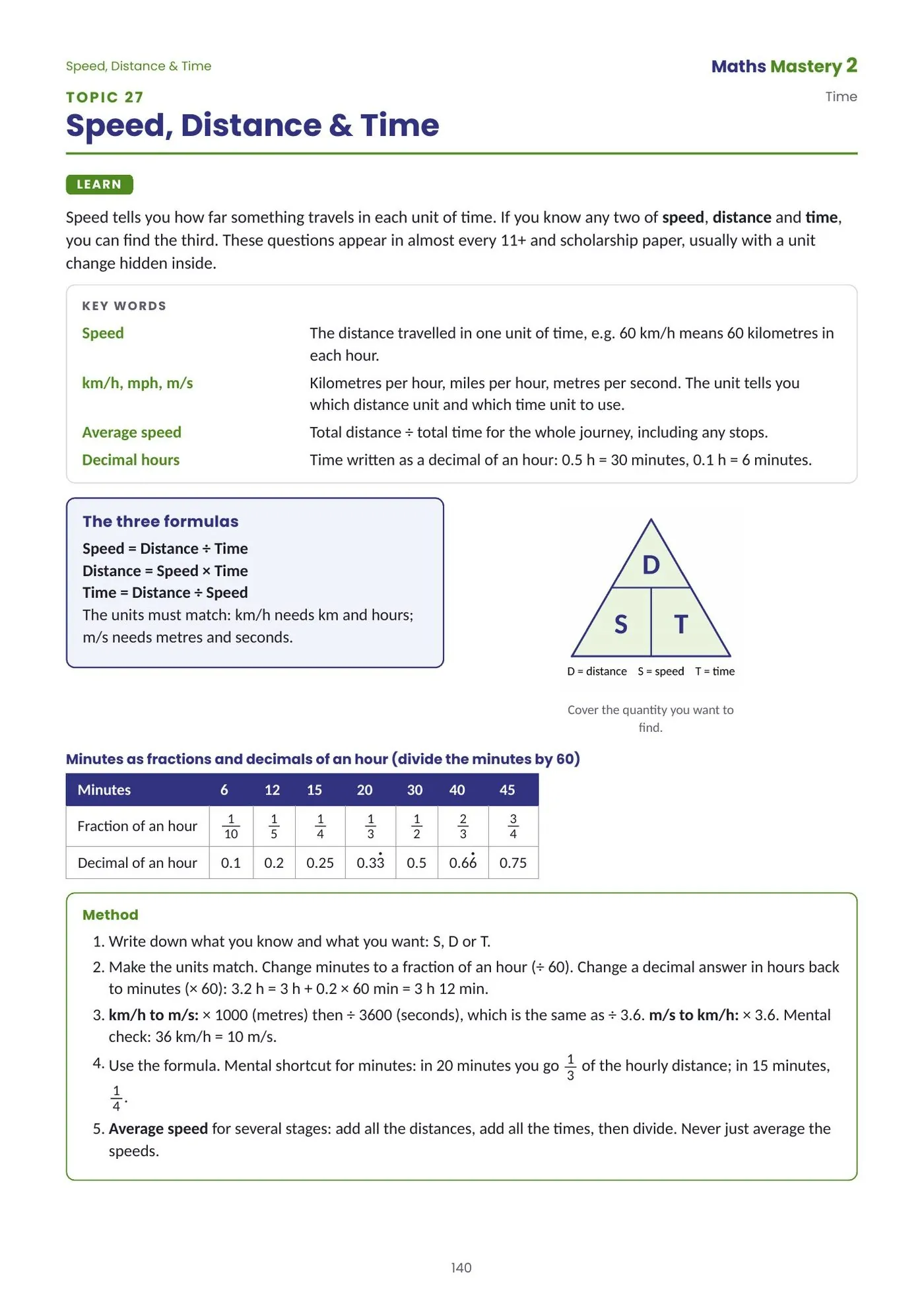
The topic in almost every 11+ paper, with the unit change hidden inside.
The three formulas, the D-S-T triangle, and the table a child needs to memorise: 20 minutes is a third of an hour, 45 minutes is 0.75. The method makes the units match before any formula is touched, and ends with the rule that catches the able child: never just average the speeds.
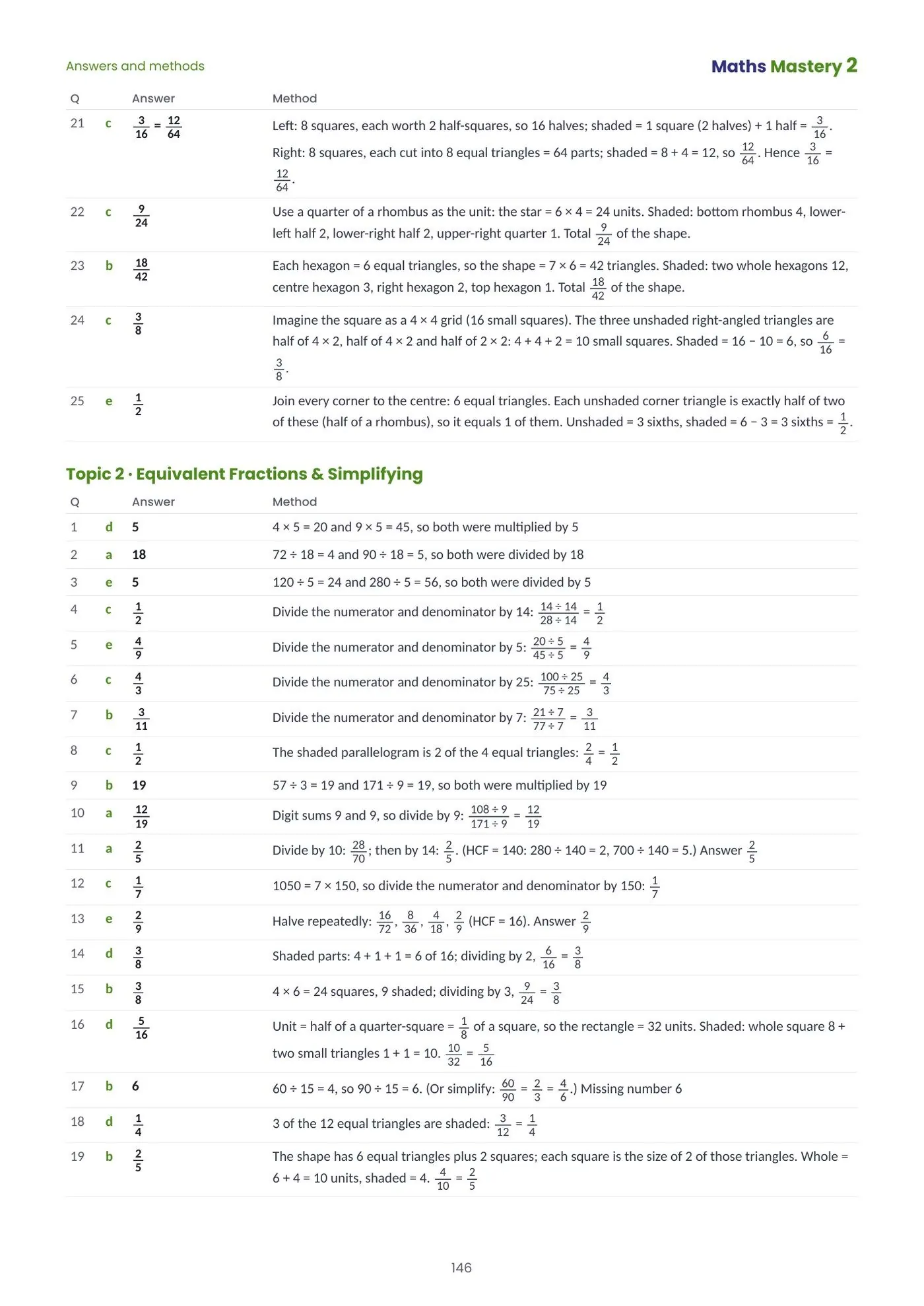
Every answer, every method, fully worked.
For the shape questions the method column shows how to see the shape: "Imagine the square as a 4 × 4 grid; the three unshaded triangles are 4 + 4 + 2 = 10 small squares, so shaded = 6/16 = 3/8." That is a tutor’s explanation, printed for every question, so the parent never has to invent one.
All 27 topics in the book follow the pattern shown here.
Other Year 4 books in Maths Mastery

Number Relationships & Decimals
Place value, number bonds, factors, multiples and decimals: the ground every later topic stands on.

Percentages, Ratios, Proportions & Probability
Proportional reasoning, the single skill that separates top-set maths from the rest.

Geometry: Shape, Space & Angles
Perimeter, area, angles, coordinates and nets, with the diagrams children actually meet in the exam.

Mental Maths Foundations
The Year 4 mental maths book. Speed and accuracy without a pen.