 Click to enlarge
Algebra
Letters, sequences and equations introduced the way the 11+ sets them, not the way textbooks do.
- A rules page before every topic, written so a parent can teach from it
- 25 multiple-choice questions per topic, graded from accessible to scholarship level
- Full answer key
- Covers the whole 11+ syllabus across Books 1–6, then applies it in Books 7–12
Want the whole series? The full Maths series is £247, under £21 a book.
How this book is used in our course
Each topic opens with a rules page. A parent reads it with the child, then the child attempts the 25 questions unaided. Mark them, log the score, and work through every wrong answer with the key. Anything under 90% is repeated after a fortnight. The topic is only finished when the cold repeat clears 90%.
Where it sits in the series
- Previous book in the series: Book 5, Statistics & Data Handling
- Next book in the series: Book 7, Maths Rules & Quick Tests
What's inside Maths Mastery 6
Five real pages from the book, so you can see exactly what your child will work from. All 9 sample pages are in the viewer.
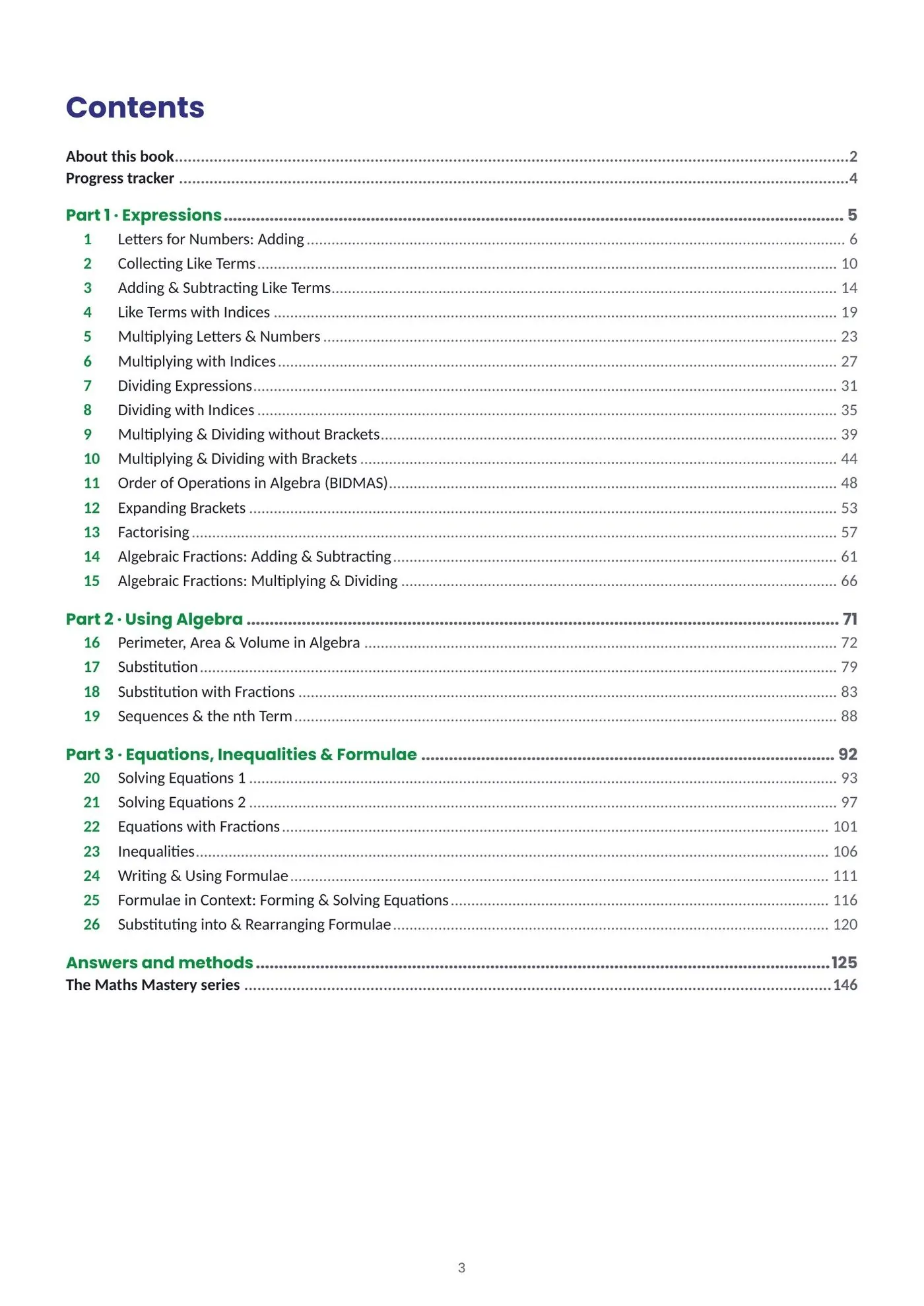
Twenty-six topics in three parts: algebra built one rule at a time, in the order the exam needs it.
Part 1 is expressions: letters for numbers, like terms, indices, multiplying and dividing, brackets, factorising and algebraic fractions. Part 2 uses it: perimeter and area in algebra, substitution, sequences and the nth term. Part 3 is equations, inequalities and formulae, up to forming and solving equations from a word problem and rearranging a formula, which is where independent school papers finish.
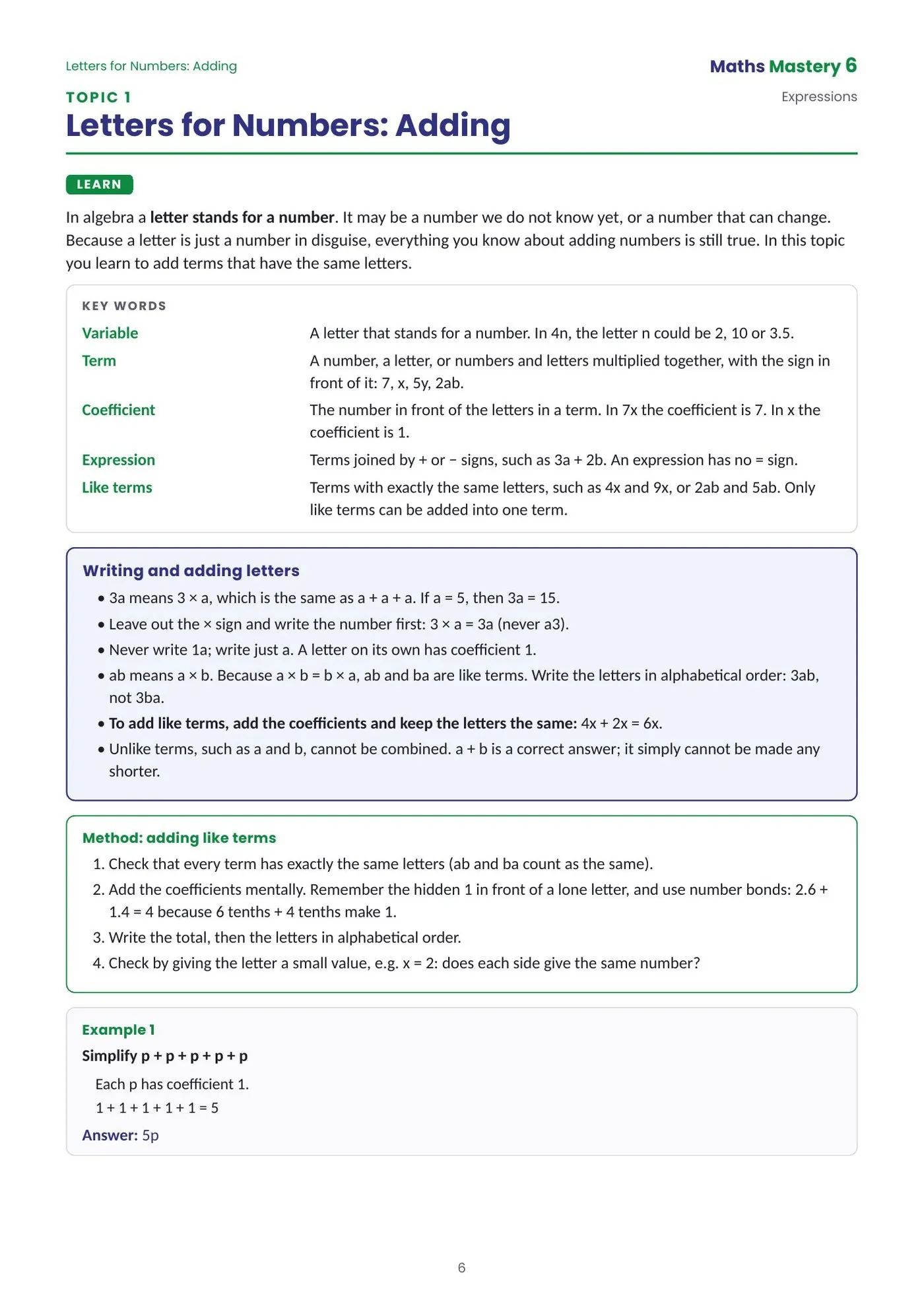
A letter is just a number in disguise, so everything you know about adding is still true.
Variable, term, coefficient, expression and like terms defined in one box. Then the habits that separate a tidy algebra answer from a marked-down one: never write a3, never write 1a, letters in alphabetical order, and a + b is a finished answer. The method ends with a check a tutor would insist on: give the letter a small value and see whether both sides agree.
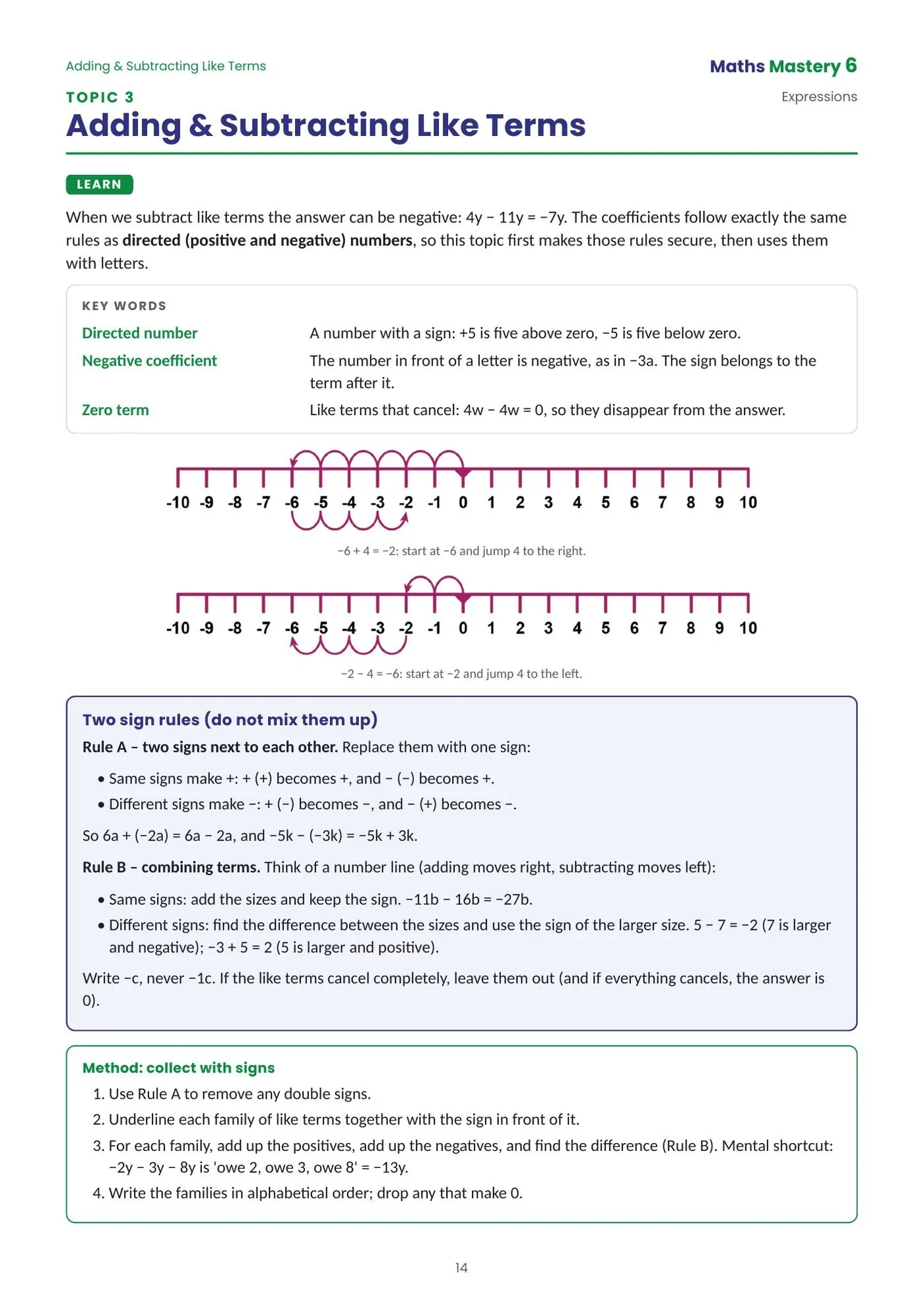
The two sign rules, kept apart, because mixing them up is the commonest error in Year 5 algebra.
Rule A is for two signs next to each other: same signs make plus, different signs make minus. Rule B is for combining terms: same signs add the sizes, different signs find the difference and take the sign of the larger. Number lines show both jumps. The mental shortcut is printed too: −2y − 3y − 8y is "owe 2, owe 3, owe 8", so −13y.
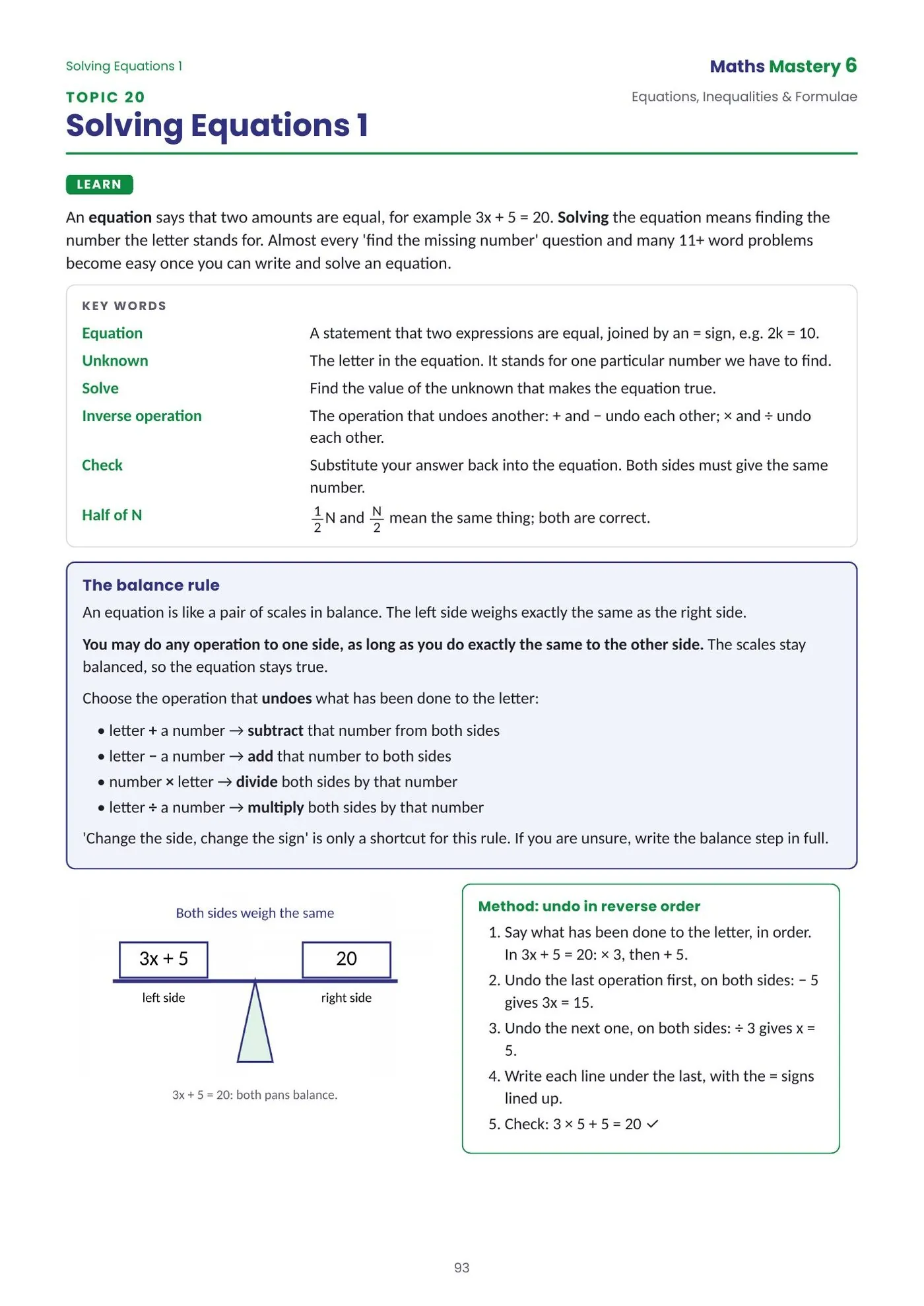
The balance rule, drawn as a pair of scales, then undone in reverse order.
Whatever you do to one side, you do to the other. The page lists which operation undoes which, and says plainly that "change the side, change the sign" is only a shortcut for the rule, so an unsure child writes the balance step in full. The method is five numbered steps for 3x + 5 = 20, with the equals signs lined up and the check at the end: 3 × 5 + 5 = 20.
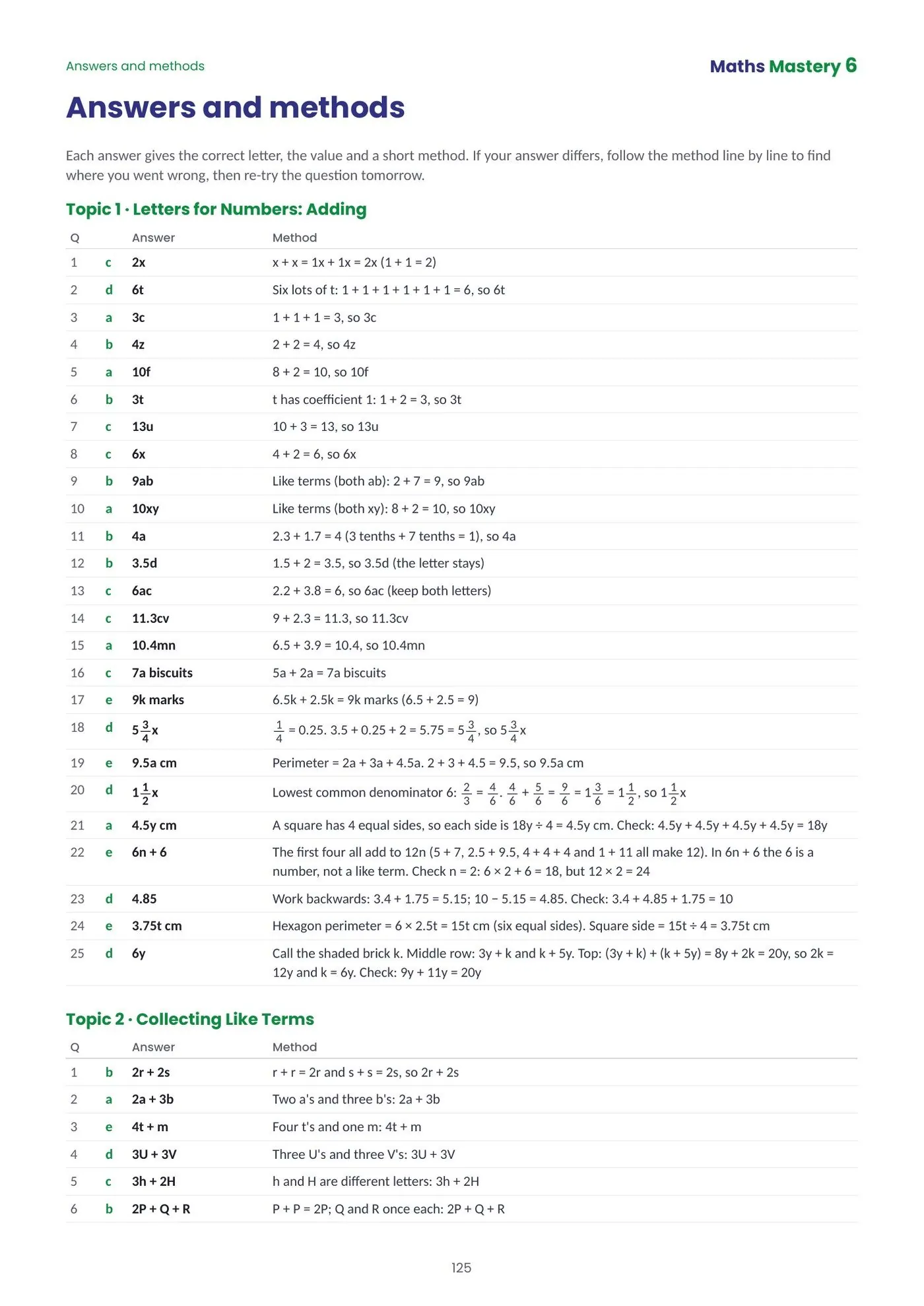
Every answer, every method, fully worked.
Question 22 explains why the distractor is wrong: "In 6n + 6 the 6 is a number, not a like term. Check n = 2." Question 25 is a number pyramid solved by calling the shaded brick k and working up, with the check at the end. Twenty-five questions in every topic, each with a method a parent can follow line by line, even if they never did algebra themselves.
All 26 topics in the book follow the pattern shown here.
Other Year 5 books in Maths Mastery

Statistics & Data Handling
Reading charts, tables and averages quickly and without errors.

Maths Rules & Quick Tests
Every rule from Books 1–6 on one page each, with a quick test to prove it is still there.

Short Maths
One-mark questions under the clock, where exams are won or lost on care.

Long Maths
Multi-step questions with marks for method, laddered to scholarship standard.