 Click to enlarge
Long Maths
Multi-step questions with marks for method, laddered to scholarship standard.
- 20 tests in ten levels of multi-step questions
- Questions built around shared tables and data, as in the exam
- Laddered to scholarship standard
- Every answer with its method fully worked
Want the whole series? The full Maths series is £247, under £21 a book.
How this book is used in our course
One test at a time, with the working written out in full so method marks are earned. Every wrong answer is reworked from the method in the answer key before the next test.
Where it sits in the series
- Previous book in the series: Book 9, Short Maths
- Next book in the series: Book 11, Mental Maths Advanced
What's inside Maths Mastery 10
Four real pages from the book, so you can see exactly what your child will work from. All 9 sample pages are in the viewer.
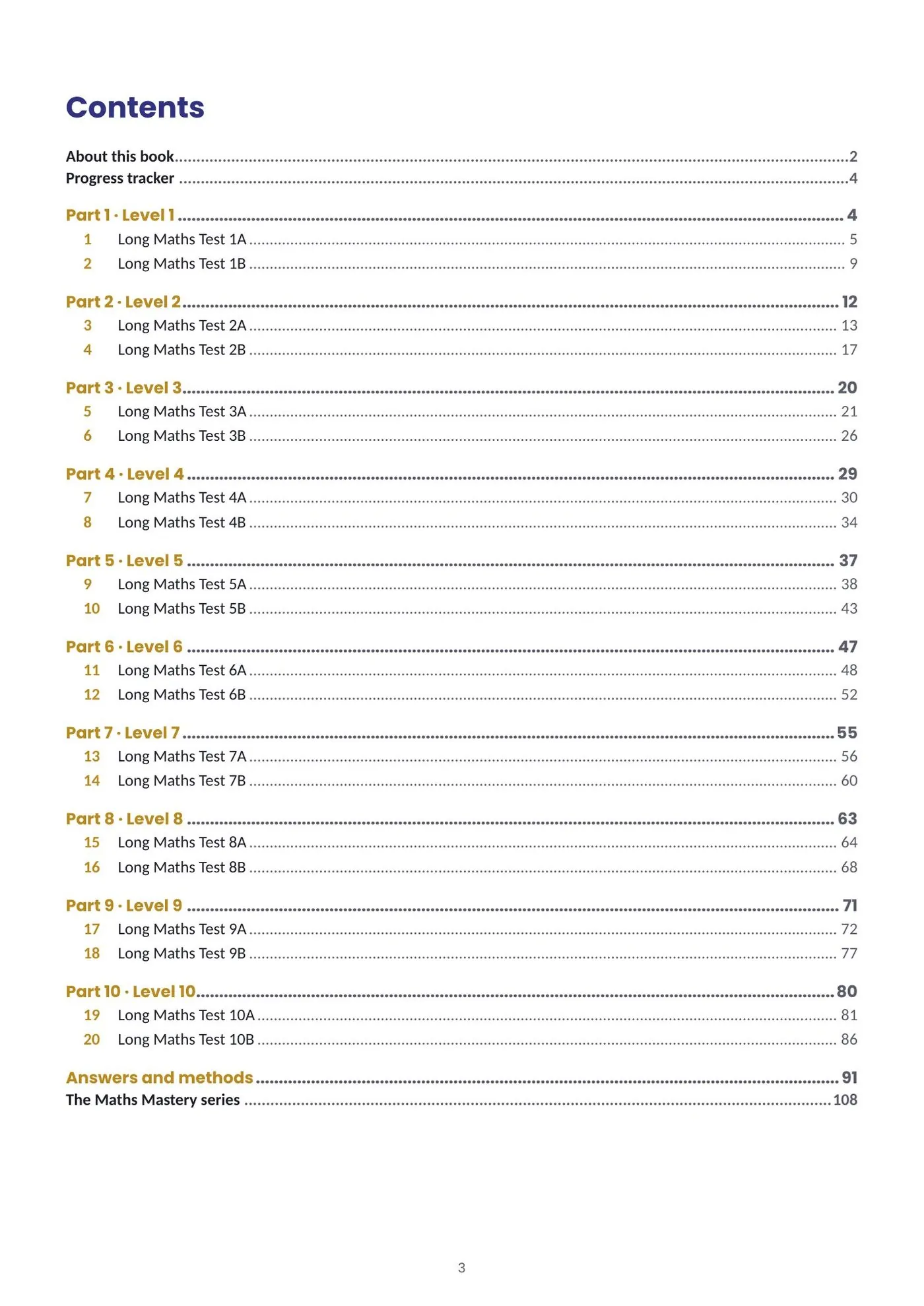
Twenty tests in ten levels: multi-step questions built around shared data, laddered to scholarship standard.
Two Long Maths tests per level, 25 questions in a suggested 45 minutes. This is the second half of the paper, and the half that separates a grammar school pass from a scholarship: a table, a diagram or a scenario, then four or five questions that build on it. Level 1 is Year 5 Term 3; Level 10 is the standard of the hardest independent school papers.
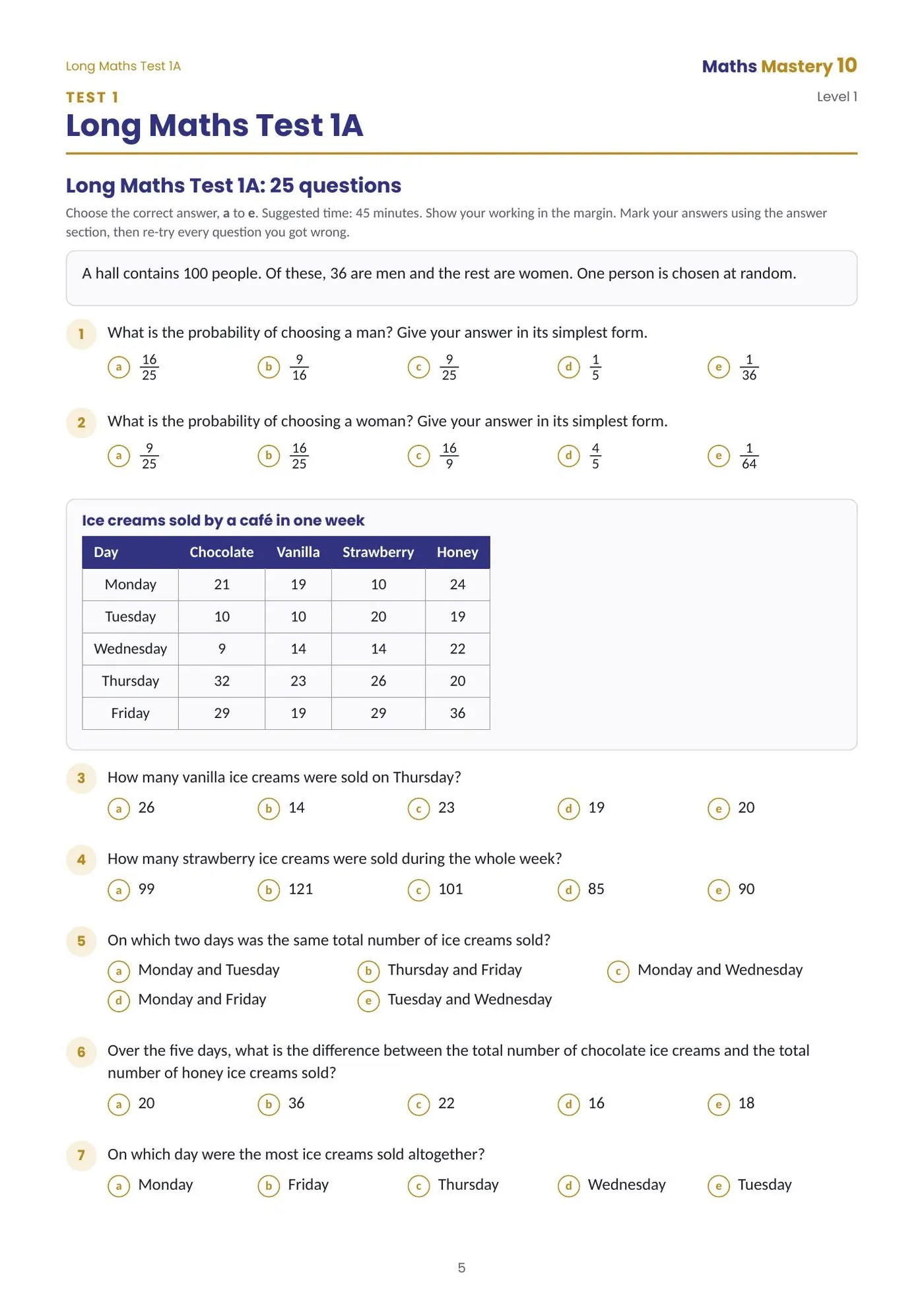
One table, five questions: the exam format most children first meet on the day.
A hall of 100 people, 36 men, then two probability questions in simplest form. Then an ice-cream table, five days by four flavours, and five questions on it: a single cell, a column total, which two days had the same total, the difference between two columns, the busiest day. A child who has only done one-line questions reads the table five times. A child who has done this book reads it once and writes the totals in the margin.
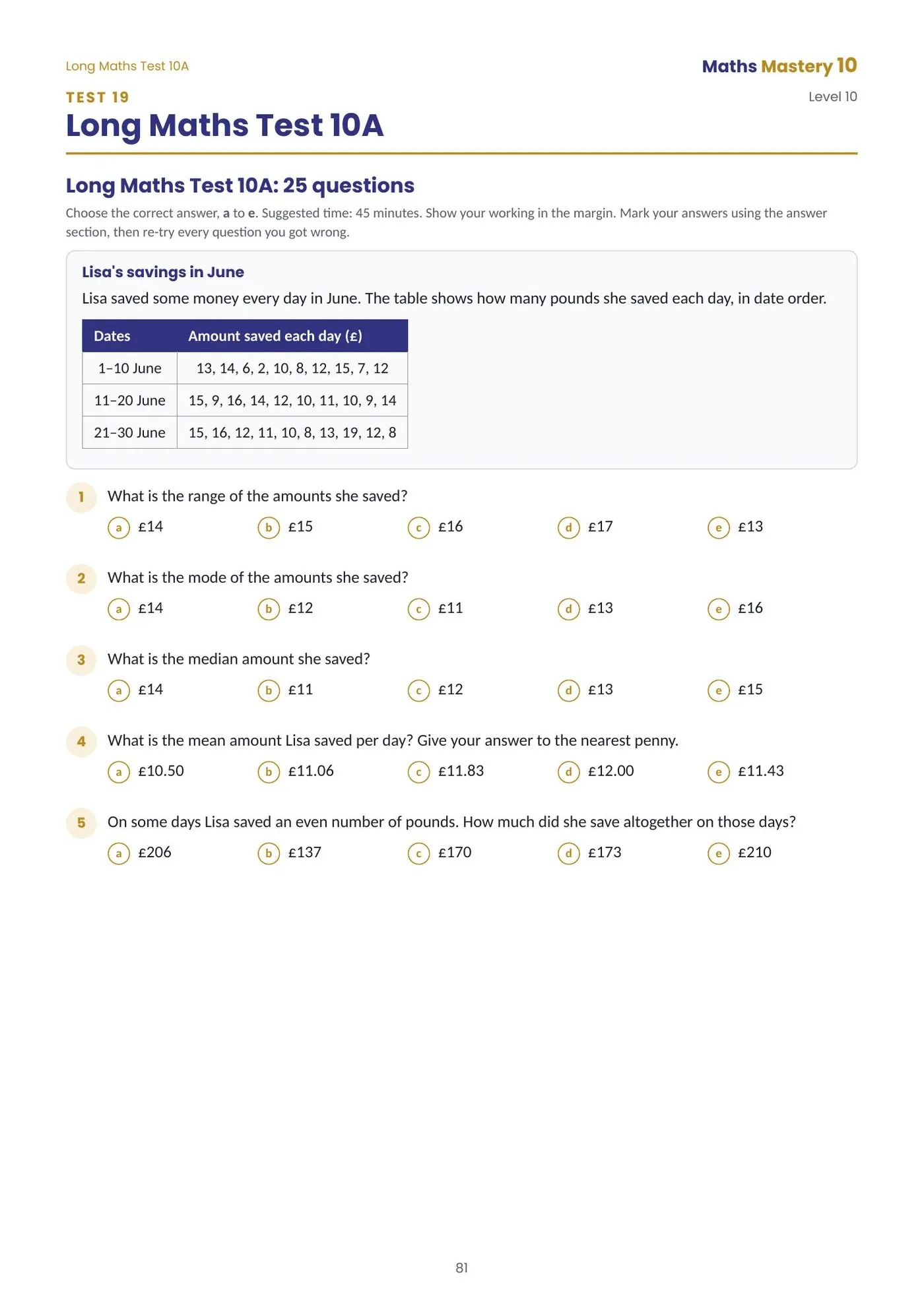
Level 10: thirty data values, and range, mode, median, mean to the nearest penny, and a filtered total, all from one table.
Lisa’s savings in June, thirty amounts in date order. Range, mode, median, mean to the nearest penny, then the total of the even-numbered days. There is no trick, only method and care: order the data once, count carefully, divide to two decimal places. This is what an independent school long paper looks like, and it is what a child who has climbed from Level 1 can now do in the time.
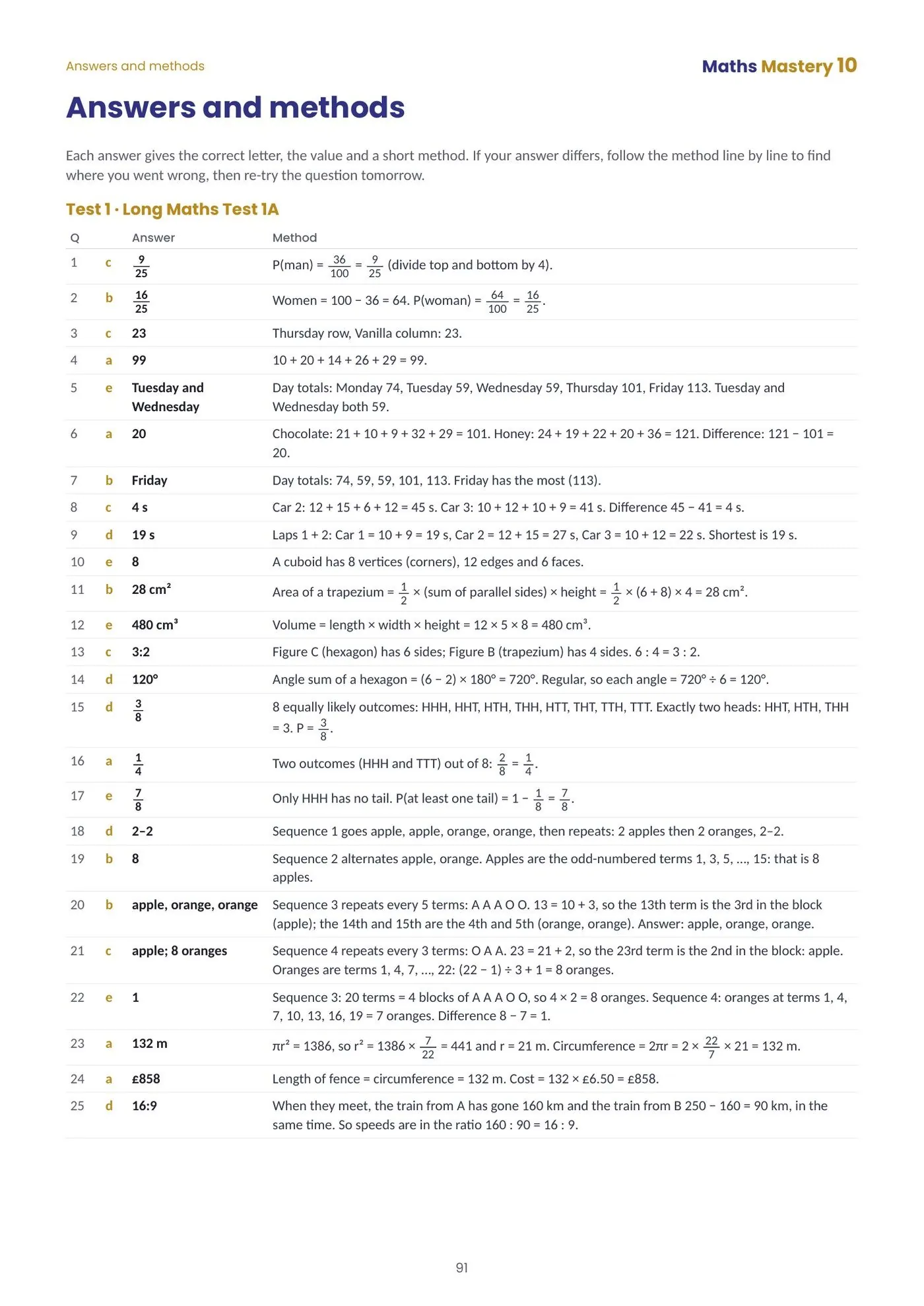
Every answer, every method, fully worked.
Question 15 lists all eight outcomes of three coins before counting the two-head cases. Question 20 finds the 13th term of a repeating sequence by dividing by the block length. Question 23 works a circle backwards from its area using 22/7, and Question 24 prices the fence. These are the written methods an examiner gives marks for, laid out the way a scholarship paper expects to see them.
All 20 tests in the book follow the pattern shown here.
Other Year 5 books in Maths Mastery

Statistics & Data Handling
Reading charts, tables and averages quickly and without errors.

Algebra
Letters, sequences and equations introduced the way the 11+ sets them, not the way textbooks do.

Maths Rules & Quick Tests
Every rule from Books 1–6 on one page each, with a quick test to prove it is still there.

Short Maths
One-mark questions under the clock, where exams are won or lost on care.