 Click to enlarge
Worded Problems Mastery
The whole syllabus turned into worded problems, graded by difficulty. The book the series builds towards.
- 14 chapters covering the whole syllabus as worded problems
- A page of key rules before every chapter
- 45 questions per chapter in three bands: Beginner, Intermediate, Advanced
- A glossary and maths reference
- Every answer with its method fully worked
Want the whole series? The full Maths series is £247, under £21 a book.
How this book is used in our course
Each topic opens with a rules page. A parent reads it with the child, then the child attempts the 25 questions unaided. Mark them, log the score, and work through every wrong answer with the key. Anything under 90% is repeated after a fortnight. The topic is only finished when the cold repeat clears 90%.
Where it sits in the series
- Previous book in the series: Book 11, Mental Maths Advanced
- This is the last book in the series.
What's inside Maths Mastery 12
Five real pages from the book, so you can see exactly what your child will work from. All 10 sample pages are in the viewer.
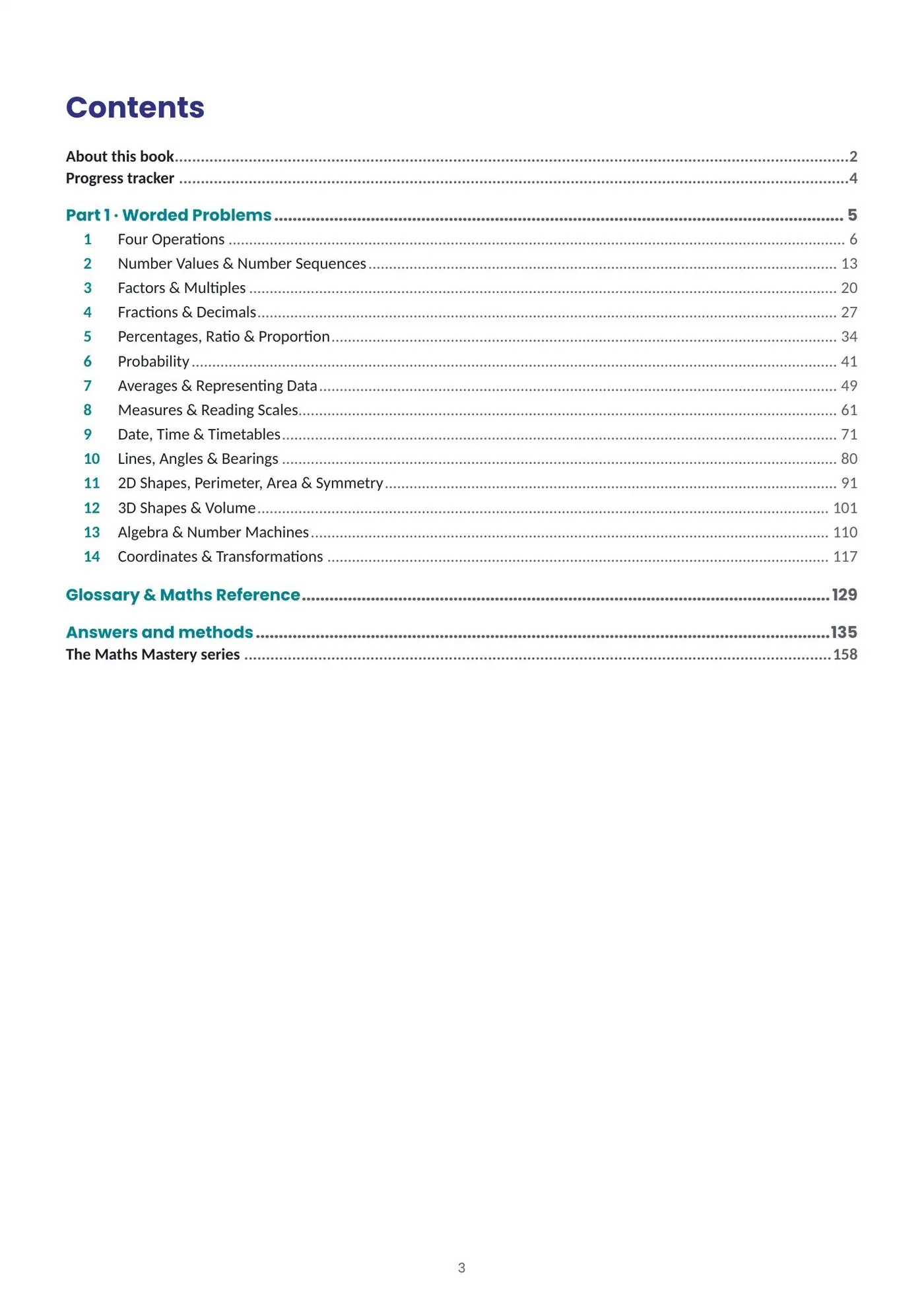
Fourteen chapters: the whole syllabus, turned into the worded problems the exam actually sets.
Four operations, number and sequences, factors and multiples, fractions and decimals, percentages, ratio and proportion, probability, averages and data, measures, date and time, angles and bearings, 2D and 3D shape, algebra and number machines, coordinates and transformations. Every chapter is a page of key rules, then 45 questions in three bands, Beginner, Intermediate and Advanced. A glossary and maths reference closes the book. This is the one the series builds towards.
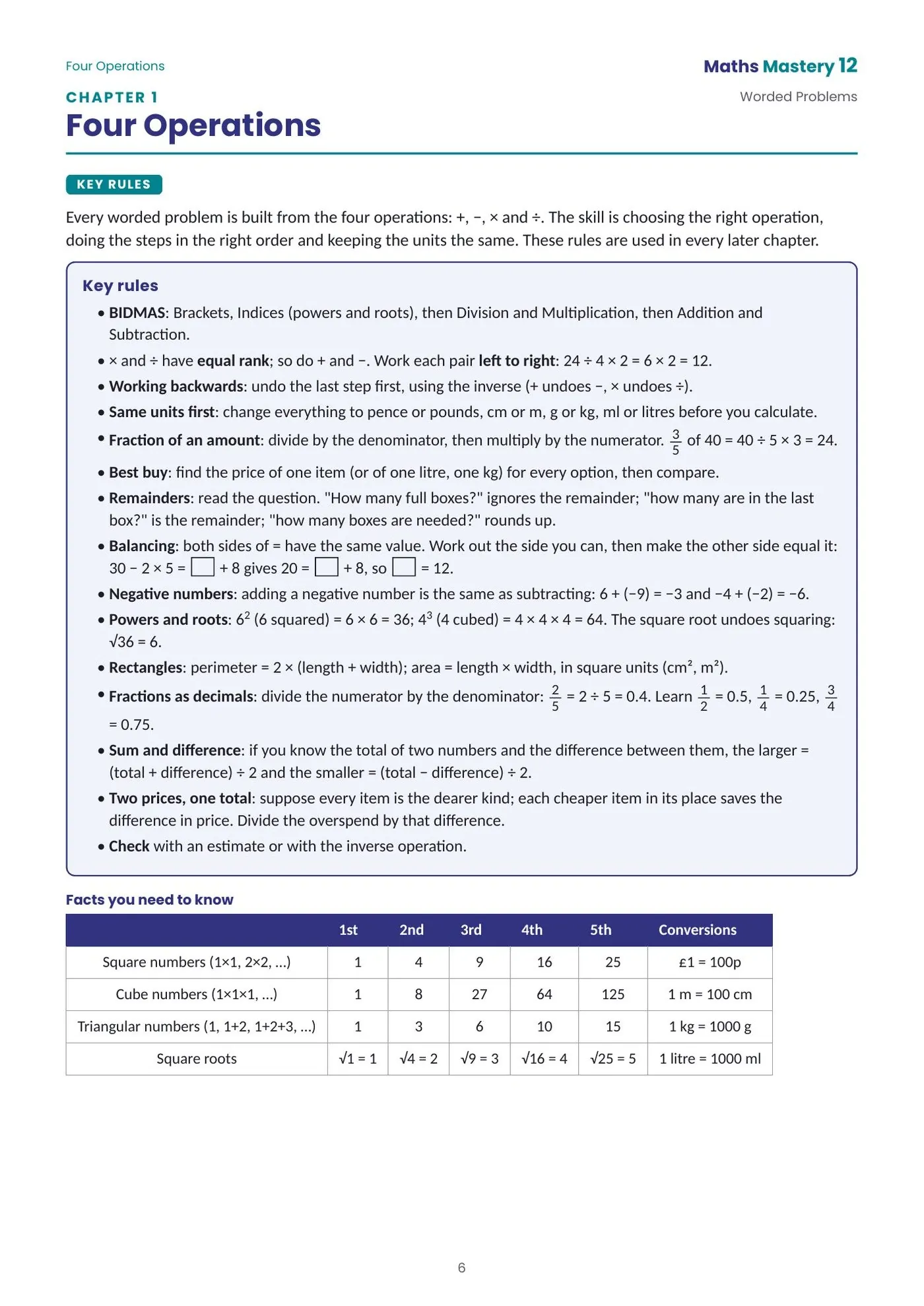
The rules that every worded problem is built from, including the ones no textbook writes down.
BIDMAS and equal rank, working backwards, same units first, fraction of an amount, best buy. Then the rules that lose marks because nobody teaches them: remainders ("how many boxes are needed?" rounds up), sum and difference (larger = (total + difference) ÷ 2), and two prices, one total (suppose every item is the dearer kind, divide the overspend by the difference). A facts table of squares, cubes, triangular numbers and roots sits underneath.
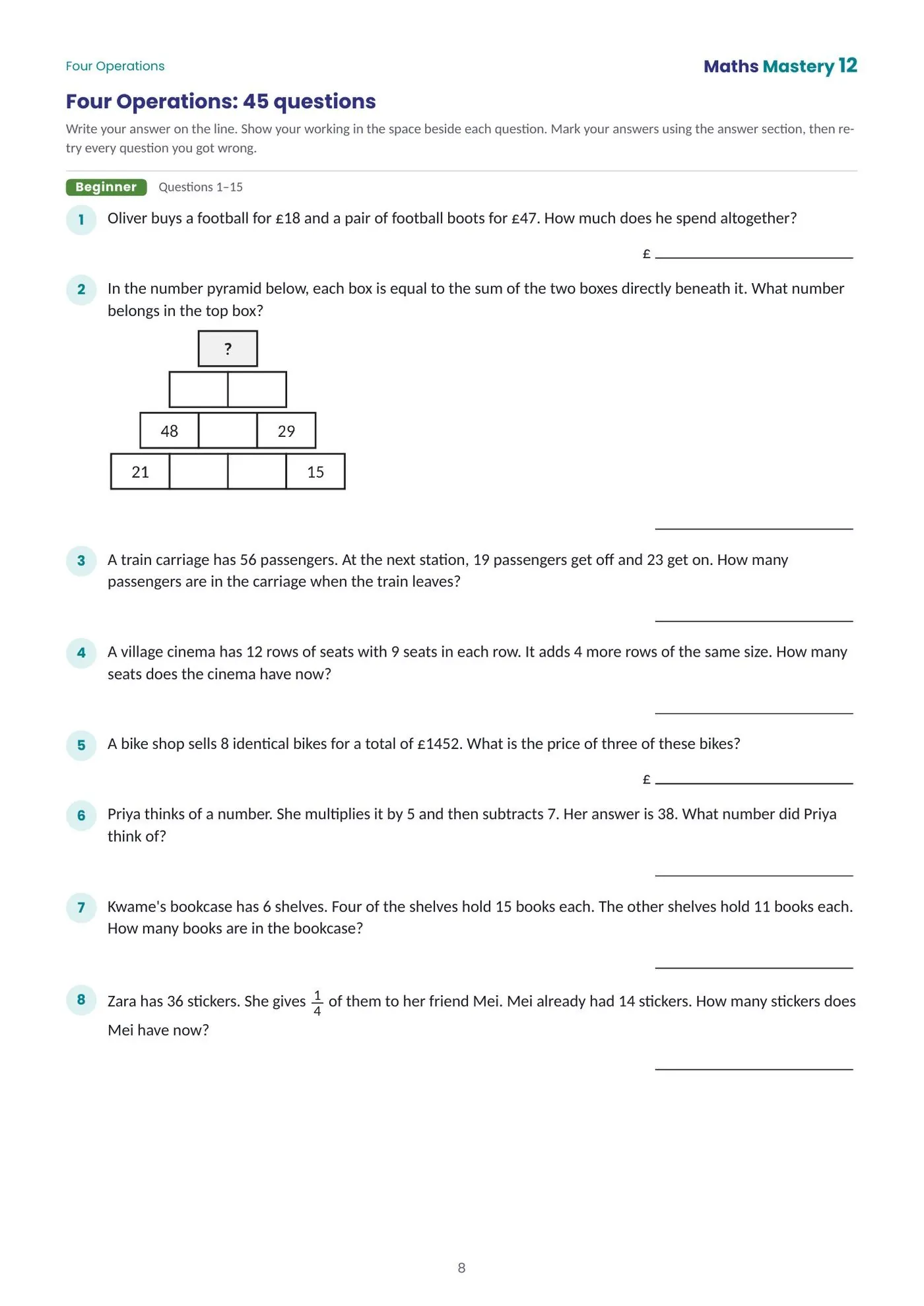
Forty-five problems per chapter, banded Beginner, Intermediate and Advanced.
Questions 1 to 15 are Beginner: a football and boots, a number pyramid, passengers on and off a train, a cinema adding rows, eight bikes for £1452 and the price of three. Each one needs a decision about which operation, and in what order, before any arithmetic. Working space beside every question and an answer line, because in the exam the method is what earns the marks.
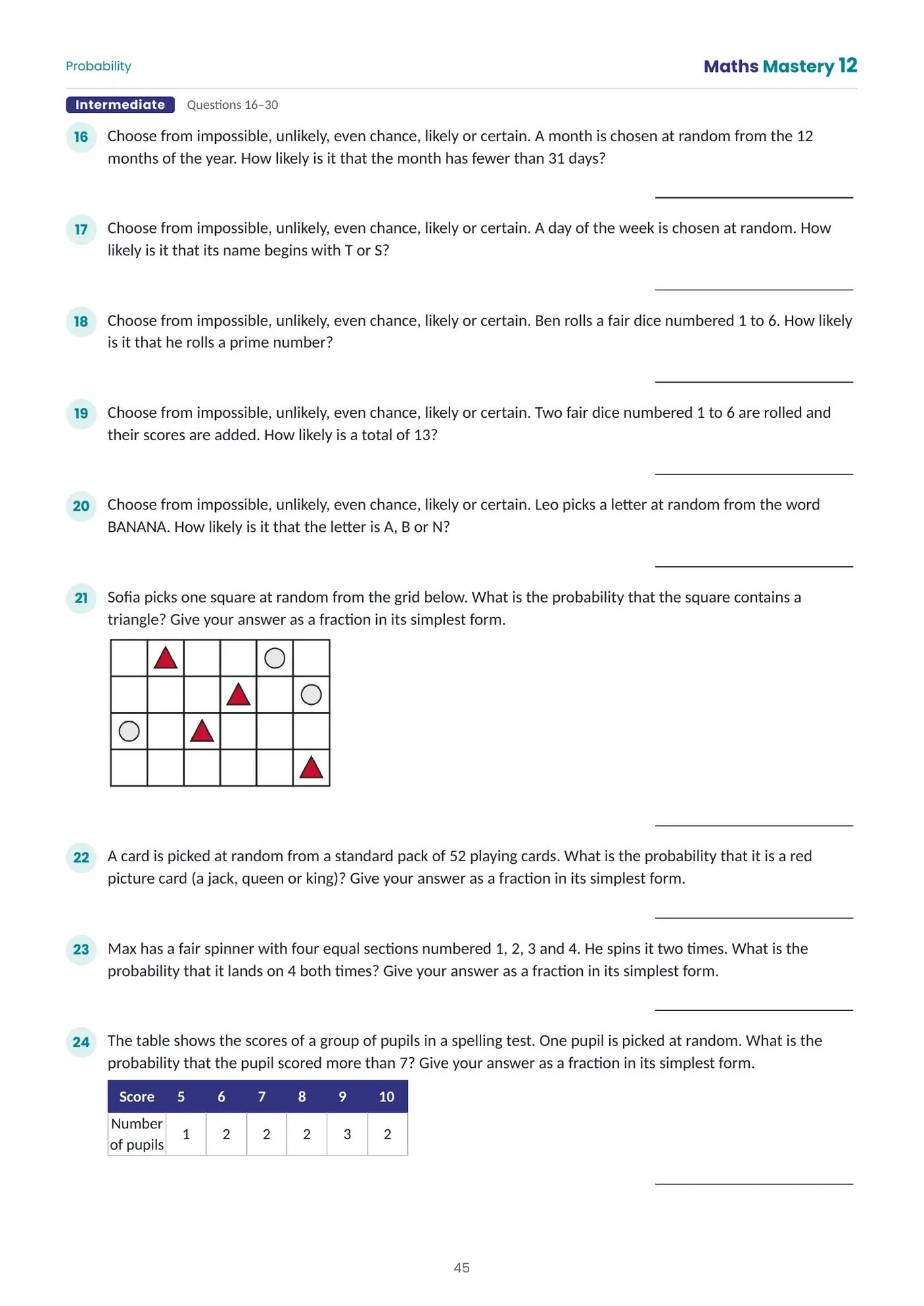
The language of the exam: "impossible, unlikely, even chance, likely or certain", then fractions in simplest form.
A month with fewer than 31 days. A day beginning with T or S. A prime on a dice. A total of 13 from two dice. A letter from BANANA. Then the same ideas as fractions: a triangle on a grid, a red picture card from 52, a spinner landing on 4 twice, a pupil scoring more than 7 from a frequency table. The question wording is the exam’s own, because that is what a child has to read correctly under time.
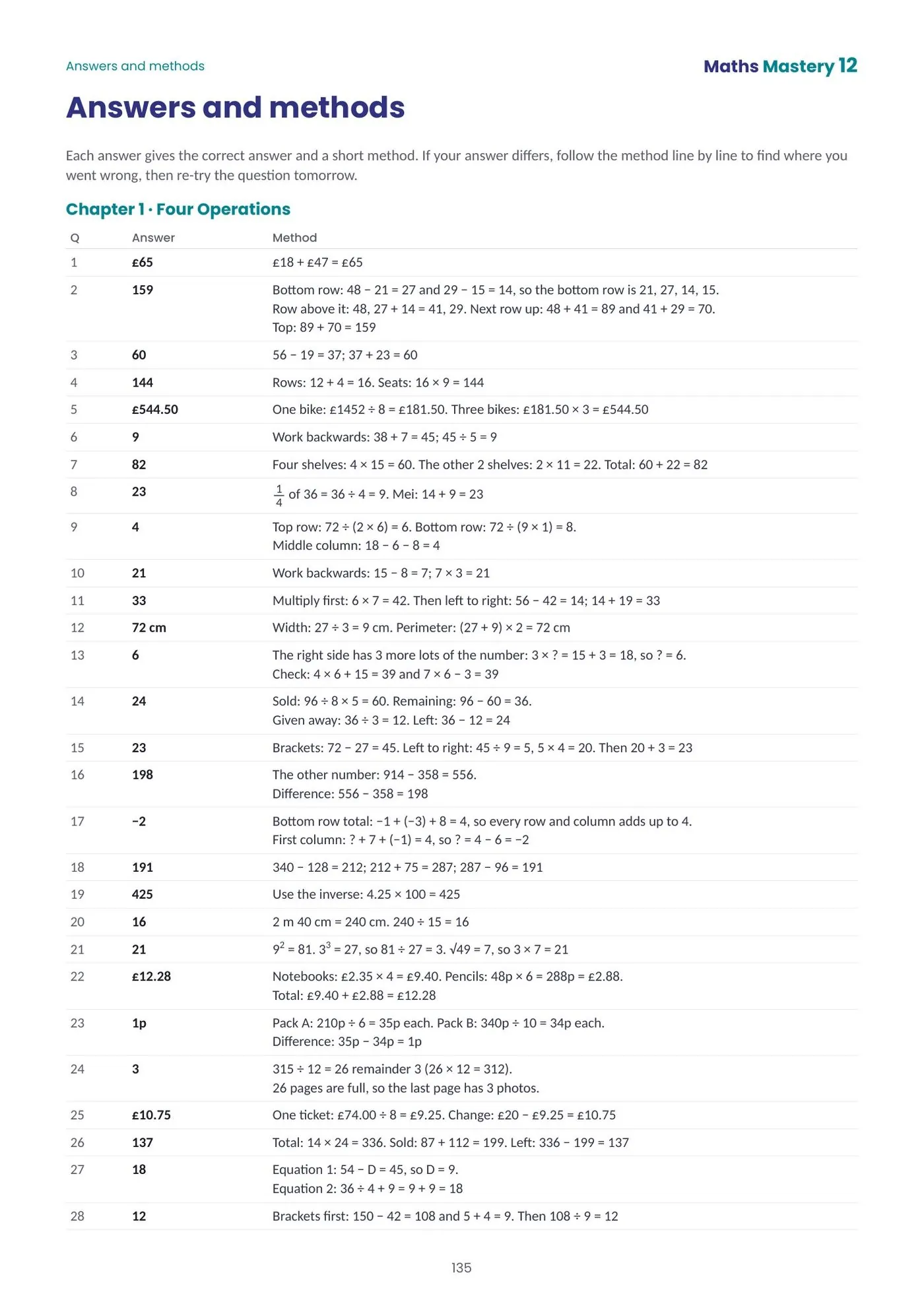
Every answer, every method, fully worked.
Question 2 builds the number pyramid row by row. Question 13 balances the two sides and then checks both: "4 × 6 + 15 = 39 and 7 × 6 − 3 = 39." Question 24: "315 ÷ 12 = 26 remainder 3. 26 pages are full, so the last page has 3 photos." Forty-five methods per chapter, written the way an examiner wants to see the working, so the child learns the layout as well as the answer.
All 14 chapters in the book follow the pattern shown here.
Other Year 5 books in Maths Mastery

Statistics & Data Handling
Reading charts, tables and averages quickly and without errors.

Algebra
Letters, sequences and equations introduced the way the 11+ sets them, not the way textbooks do.

Maths Rules & Quick Tests
Every rule from Books 1–6 on one page each, with a quick test to prove it is still there.

Short Maths
One-mark questions under the clock, where exams are won or lost on care.